
Stability and Shelf-Life Testing: A Checklist for a Spa or Hotel Fragrance Line
A spa or hotel line lives on the shelf longer and meets more conditions than a retail fragrance, so its stability data is not paperwork, it is the specification. The questions that matter are whether the scented product holds its appearance, colour, odour, pH and viscosity in the conditions your venues actually reach, and whether the preservative system does its job over the stated shelf life. Buyers who commission the right tests and read them against a checklist get a line that behaves the same in year one and year three; buyers who skip them discover the failure inside a guest bathroom.
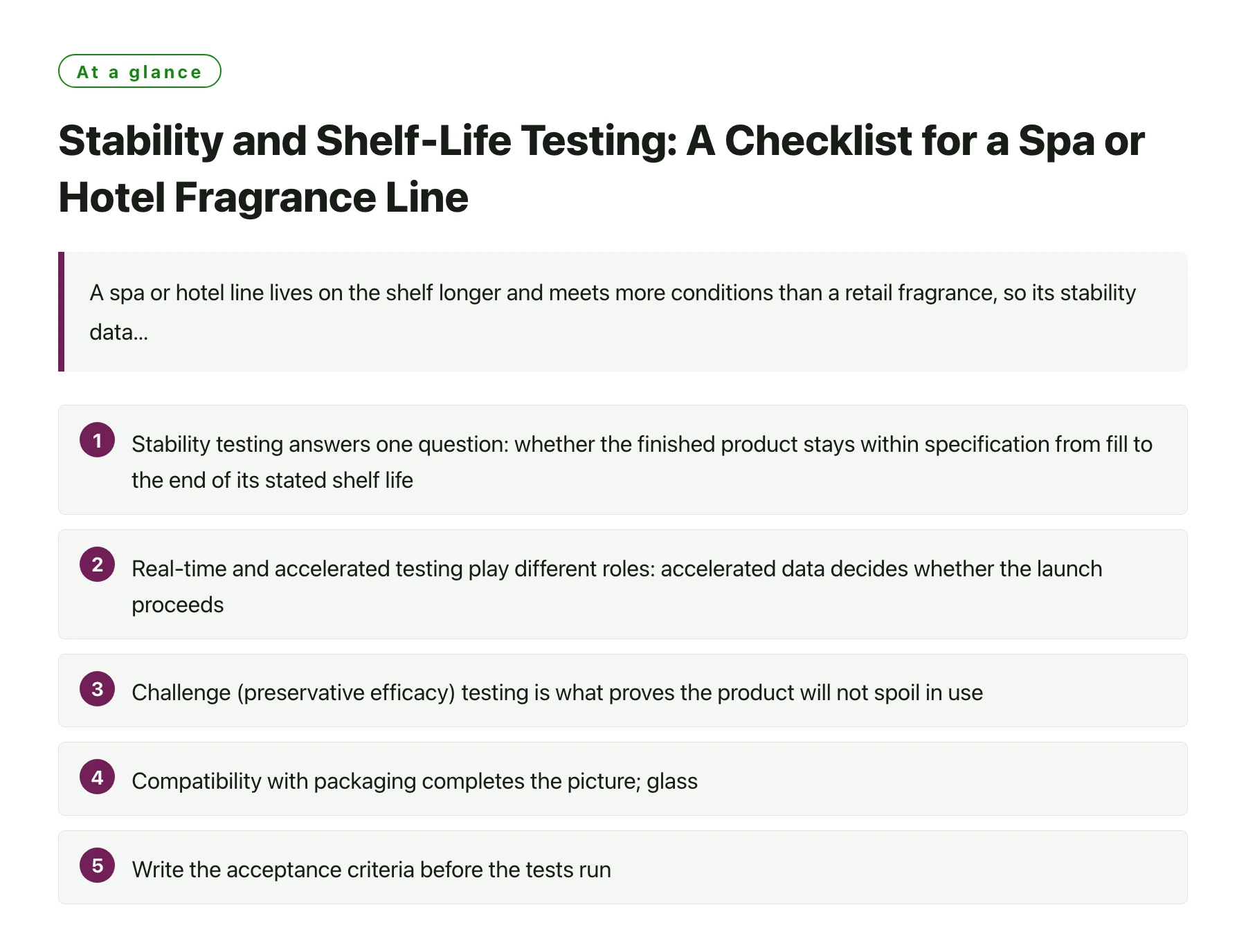
Key takeawaysStability testing answers one question: whether the finished product stays within specification from fill to the end of its stated shelf life, in the conditions it will actually meet. · Real-time and accelerated testing play different roles: accelerated data decides whether the launch proceeds, real-time data confirms the shelf-life claim. · Challenge (preservative efficacy) testing is what proves the product will not spoil in use, and it matters more for amenities that are opened, dipped into and closed repeatedly. · Compatibility with packaging completes the picture; glass, closures, pumps and labels all interact with the product over time. · Write the acceptance criteria before the tests run, so that “passed stability” means the same thing to the factory and to the buyer.
Hotel and spa amenities are a peculiar category: small formats, long storage, high turnover of users, and a brand that is judged every time a bottle is picked up. The shelf-life question is therefore not academic. A lotion or scented body wash that separates, discolours or loses its scent in month eight will be discovered in a guest room, not in a lab notebook.
What follows is the checklist used when commissioning a private-label line for hospitality: the tests to ask for, the results to demand, and the decisions to extract from them. It applies whether you bring the formula or the manufacturer develops it for you.
Why stability is the specification, not the paperwork
For a fragrance concentrate the physical job is simple: stay clear and stay on-scent. For a scented body product it is bigger: the emulsion has to hold, the pH has to stay in range, the colour and odour must not drift, and the preservation system has to keep the product safe at every moment of use. The cosmetics industry treats this as a core part of product development, and published guidelines exist for how stability testing should be designed [1].
For hospitality specifically, the test conditions should mirror the real world: warm storerooms, partially used bottles that are opened and closed for months, and occasionally sunlit bathrooms. A product that is stable at a comfortable lab temperature may still degrade in the corridor cupboard next to the boiler.
When the manufacturing partner runs several categories under one roof and works to a GMP framework such as ISO 22716, the stability data sits inside the same quality system as the batch records, so it can be checked rather than trusted [2]. And when the manufacturer develops the product rather than merely filling it, a full ODM fragrance service should hand over the stability data as part of the deliverable, not as an extra.
The test set a spa or hotel line should ask for
| Test | What it proves | What to check on the report |
|---|---|---|
| Real-time stability | The product holds specification at normal storage over the claimed shelf life | The intervals tested, and that the latest points still pass |
| Accelerated stability | Early warning of future failures via heat and humidity cycling | The conditions used, and whether any early attribute already drifted |
| Preservative efficacy (challenge test) | The product stays safe once opened and used over weeks | The organisms tested and the log reductions at each read |
| Packaging compatibility | The formula does not react with glass, closures, pumps or labels | Any colour change, odour pickup or dimension change |
| Batch-to-batch check | Production runs repeat the approved sample rather than approximate it | Retained samples and recorded readings against the reference |
A single stability report is a minimum. For a line of several SKUs, each one needs its own data, because a gel and a lotion will not fail at the same point.
Building the stability program with your supplier
- Define the shelf-life target and storage realityDecide the claimed shelf life and the worst real conditions, heat, light, partially used bottles, then design the tests around them.
- Set the acceptance criteria in advanceWrite down the permitted drift in colour, odour, pH, viscosity and appearance before any testing starts.
- Book the testing into the calendarAccelerated cycles take weeks and real-time cycles take months; they have to be scheduled before production, not discovered after it.
- Review against the checklist, not against the word “passed”Read the actual readings; “passed” without data is a claim, and a claim is not a stability report.
- Keep the released batch as the referenceRetain the approved batch sealed and dated so later production can be compared against a physical standard, not a memory.
Where hotel lines fail first
In practice the first failures show up in three places. The preservative system is first: a challenge test designed for a large retail bottle may not cover the slow, repeated exposure of an amenity bottle opened by a hundred different hands. Second is packaging interaction: a low-cost pump or cap can leach or absorb, and the odour changes in month four even though the formula is fine.
Third is the fragrance itself sinking or shifting inside the body product. That is why the fragrance development and the base formulation have to be tested as one unit, not as two departments that met once. Readers coming from a perfume-only background will recognise the underlying pattern from safety testing in perfume manufacturing; the body care variant simply adds emulsion, pH and challenge testing on top.
All of this is a coordination problem as much as a chemistry problem. A partner offering Xuelei OEM/ODM services usually carries the fragrance, the base, the stability testing and the filling inside one quality system, which is exactly the arrangement that produces readable data instead of a folder of mismatched certificates.
On the safety side, the preservatives used in cosmetics are regulated ingredients, and their choice and levels are a compliance decision rather than a formula detail [3]. If your line claims a shelf life, the data has to support it in every market where the claim appears.
If the report only says “passed”, someone has not read the report. A usable stability file shows the conditions, the intervals, the readings and the signed review. Those four elements are what turn “the factory says it is stable” into a product decision you can defend.
Sources
- Cosmetics Europe —— The European trade association for the cosmetics and personal care industry, publishing guidance, positions and market information.
- SGS: Cosmetics, Personal Care & Household Testing —— Testing, inspection and certification services for cosmetics and personal care, including microbiological, stability and safety testing aligned with cosmetics GMP.
- EU CosIng — Cosmetic Ingredient Database (European Commission) —— The European Commission's CosIng database of cosmetic ingredients, listing ingredient functions, restrictions and labelling requirements under EU cosmetics law.
Frequently asked questions
How long does stability testing take?
Accelerated studies typically run about three months, and real-time studies run the length of the claimed shelf life, often one to three years. Both can run partly in parallel, but they have to be scheduled before production.
Do I need stability data for every SKU in the line?
Yes. Different bases and packaging age differently; sharing one report across a gel, a lotion and a mist assumes they fail at the same point, and they usually do not.
What does a challenge test mean for an amenity bottle?
It inoculates the product with typical spoilage microbes and measures whether the preservative system controls them within defined times. For repeatedly opened amenities, it is the test that justifies the claim that the product stays safe in use.
Can I shorten the shelf-life testing to save time?
You can launch on accelerated data and confirm with real-time data later, but the claimed shelf life still needs support. Shortening the tests shortens the claim, not the risk.
Who owns the stability data, me or the factory?
Settle it in the contract. In practice the manufacturer generates it under its quality system and you should receive it with the batch documentation; if you later change factories, the data follows the formula, so keep copies.
Shop 12,400+ vet-authorized medicines.
From flea & tick preventives to compounded cat thyroid chews — reviewed by a DVM, priced 31% below clinic retail on average.
This article is for educational purposes only and does not replace veterinary care. Always consult your licensed veterinarian before starting, changing, or stopping any medication or supplement for your pet.